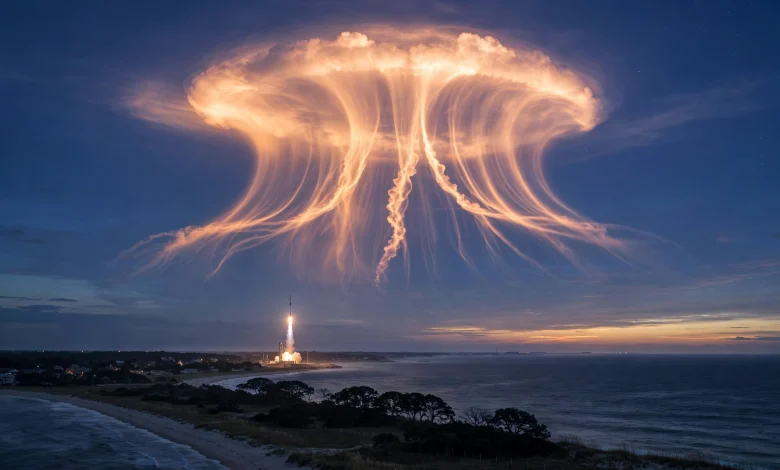
Early risers along the US East Coast were treated to an unusual sight this week when a SpaceX rocket launch painted the dawn sky with a glowing, tentacled cloud that quickly spread across social media. The phenomenon, often called a “jellyfish cloud” or space jellyfish, appeared as the rocket climbed through the upper atmosphere while the ground below was still in darkness, creating a bright, expanding bloom that looked almost alive against the twilight.
According to reporting by The Guardian, the display was visible off the US East Coast shortly after launch, with witnesses sharing photographs of a luminous cloud fanning out behind the vehicle. It is not smoke in the ordinary sense, and it is not a weather event. It is sunlight, geometry and rocket exhaust combining at exactly the right moment.
What Actually Creates a Jellyfish Cloud?
The effect begins with timing. When a rocket launches just before sunrise or just after sunset, observers on the ground stand in shadow while the vehicle quickly climbs into sunlight high above them. Exhaust gases released in the thin upper atmosphere expand rapidly because there is so little air pressure to hold them together. Those expanding gases catch the sun’s rays and glow brightly, even though the sky near the horizon still looks dark blue or black.
The result is a distinctive shape: a bright head where the exhaust is densest, trailing into wispy, curved tendrils as the plume spreads and drifts. That is why the comparison to a jellyfish is so persistent. The plume appears to pulse and bloom rather than stream in a straight line, and as different layers of exhaust catch the light at different angles, colours can shift from white and gold to soft pink and blue.
Why This Launch Was Seen So Far Away
Altitude is the second ingredient. A plume released tens of kilometres above the surface is not blocked by buildings, hills or haze in the way a ground-level light would be. Anyone with a clear view of the horizon along a long stretch of coastline can potentially see it, which explains why reports and photographs of a single launch often come in from several states at once.
Weather plays a supporting role too. Clear skies, low humidity near the ground and a dark backdrop make the contrast far stronger. On a cloudy morning the same launch might pass almost unnoticed, its plume hidden behind cloud decks. This time, conditions lined up, and the display became the kind of shared public spectacle that modern rocket launches increasingly produce.
That growing visibility is part of a wider shift in how people experience spaceflight. Launches that were once followed mainly by enthusiasts are now routine coastal events, watched from beaches, balconies and motorway bridges — much like the consumer technology covered in our look at how smart glasses are bringing new attention to wearable technology.
A Sign of How Routine Spaceflight Has Become
There is a serious point behind the pretty pictures. Jellyfish clouds are becoming more familiar because launch cadence has risen sharply. Commercial crews, satellite constellations and national missions now lift off so frequently that the side effects of rocketry — sonic booms, glowing plumes and re-entry trails — are becoming part of everyday coastal life for millions of people.
That frequency also drives the engineering race underneath it. More capable rockets, reusable boosters and faster turnaround times depend on advances in propulsion and computing, a theme we explored in our coverage of how next-generation chips are reshaping the race for faster computing. Each spectacular dawn launch rests on thousands of unglamorous improvements in materials, software and guidance systems.
How to Catch the Next One
If you want to see a jellyfish cloud yourself, watch for launches scheduled in the hour before sunrise or the hour after sunset, and choose a spot with an unobstructed view in the direction of the launch site. Give your eyes a few minutes to adjust to the dark, and look higher than you might expect: the most striking part of the display often unfolds well above the horizon, several minutes after lift-off, when the vehicle reaches sunlit altitude.
Photographers suggest using a tripod and a slightly longer exposure, because the plume’s faint outer tendrils are easy for the eye to see but harder for a phone camera to capture in automatic mode. Above all, be patient. The bloom can take a minute or more to develop, and its most beautiful phase is often brief.
The Takeaway
The jellyfish cloud over the East Coast was a reminder that spaceflight is no longer something that happens far away, watched only on screens. It happens overhead, in public, and sometimes it transforms an ordinary dawn into something unforgettable. As launch schedules grow busier, more early risers can expect to look up and find a glowing jellyfish drifting through the twilight — no telescope required.