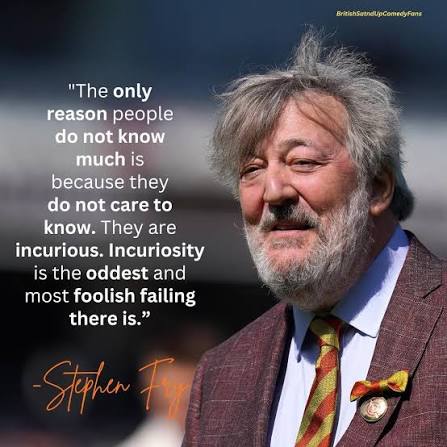
Having watched the evolution of success and failure for decades in a rapidly changing world, I have developed an unconventional opinion about the key factors of success. Those who are successful in life are those who know less in terms of absolute information than others but who remain the most curious people ever to learn more, explore, and be interested in new knowledge. Curiosity wins over knowledge in this ever-changing world, and it is time to understand why.
Knowledge ages, curiosity compounds
Knowledge that has been gathered is perishable. As the world changes and evolves and the individual continues to depend on the same stock of knowledge, he or she begins to lag behind. Curiosity, on the other hand, is a multiplier effect. The curious individual continues to gain and learn about new things as the world changes, thus becoming more relevant. In the long run, therefore, the curious learner, despite having begun with less, will end up surpassing the knowledgeable expert simply because of the multiplicative nature of curiosity.
This is not a statement against knowledge, which of course is important, but an attack on the idea of knowledge as something fixed rather than dynamic. The importance of knowledge does not lie in what you know right now but in your ability and hunger for learning more, as it is your hunger for learning that makes sure your knowledge stays relevant in the changing world. The curious make themselves relevant all the time, but the learned grow irrelevant with the same slow progress.
Curiosity drives adaptation
The simple reason why curiosity comes out on top is that it leads to adaptation. When someone is truly curious about something, he would learn the changes, discover how to use the latest tools or concepts, and adapt himself accordingly, all without effort because he enjoys doing so. On the other hand, a person who lacks curiosity sees change as a challenge; thus, he avoids change and ends up left behind as the rest of the world continues to progress.
Curiosity also determines how one deals with new technology, engaging with it through curiosity and not avoiding or fearing it. A curious person will happily explore these AI tools and many others, learning what they offer and how to use them well, which is exactly the adaptive openness that keeps a person relevant as the tools keep changing.
The joy that sustains learning
There is one additional benefit of curiosity: it enables sustained learning. Learning motivated by fear or compulsion is difficult and draining; however, learning motivated by curiosity is rejuvenating and self-perpetuating. Curiosity compels the individual to continue learning not because he or she has to but because he or she wants to, thus enabling him or her to pursue lifelong learning, something that the fear-based approach to learning will not allow. Curiosity transforms the requirement of constant learning from a daunting task into an enjoyable process.
The importance of such sustainability cannot be overstated since we live in a time where everyone needs to engage in continuous learning and the obligation-led form of such continuous learning can be rather harsh. Curiosity transforms it into something pleasant, making us want to go through the process of adaptation and change because it becomes exciting and interesting. And those who are driven by their curiosity enjoy this process while those driven by obligations give up very quickly.
Cultivating curiosity
Given that curiosity is such an important trait to develop, the positive aspect is that it is also one that is highly trainable. It comes from pursuing what you are passionate about, from allowing yourself to indulge your interest in new experiences, from being open-minded when meeting something new rather than close-minded. The more you practice your curiosity, the easier it becomes, until you find yourself exploring out of sheer instinct. Keeping and nourishing your curiosity, despite everything that might try to diminish it, is an incredibly important thing you can do for yourself.
Staying curious
For long-term success, it pays to know less about what is most correct today and instead spend your time cultivating curiosity to learn forever. Approaching new options like a faddyai free tools stack with curiosity rather than resistance is a small example of the adaptive openness that keeps a person relevant for the long haul.
The future is for the curious, not the experts of today, as knowledge becomes outdated, but curiosity grows and fosters the process of constant adaptation and learning that the world requires. It turns learning into a habit that one can live by because it transforms adaptation from a source of exhaustion into an endless journey of discovery and delight. Foster your curiosity, be deliberate in nurturing it, and be open to the novel, and you shall remain relevant for as long as those who relied on their old expertise quietly fade away.
The single best piece of advice I could offer to anyone concerned about their relevance in the modern world is that he or she should stop worrying about knowing enough and instead should concentrate on being curious enough. Because the former will always lead to a futile race with time that cannot be won; whereas the latter is guaranteed success because curiosity breeds the very knowledge that enables change and makes the process enjoyable and pleasurable at the same time. The ones I have seen flourish through the years are those who had a never-ending hunger for learning and not necessarily those who knew the most at any particular point in time. Nurture this hunger for knowledge, satisfy it and follow where it takes you, and you will stay relevant to the end of your curiosity, which in turn might well be your life.