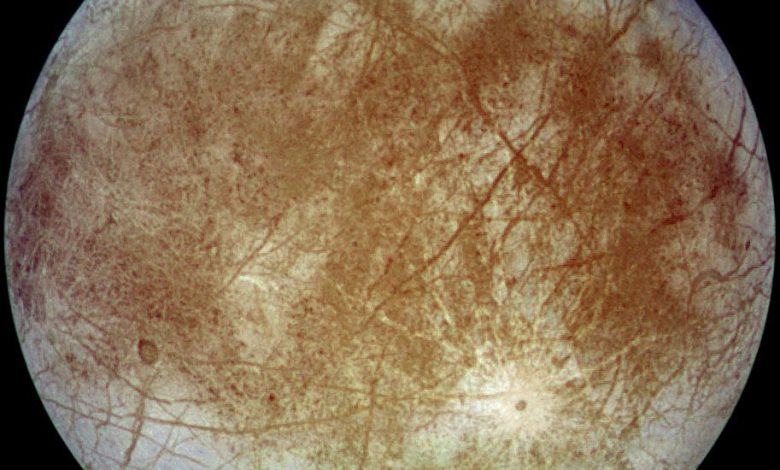
Europa’s icy crust may hide shallow lakes of liquid water, according to new models of how Jupiter’s moon freezes, cracks and slowly churns beneath its bright surface. Planetary scientists have long known that a deep ocean almost certainly lies under the ice, kept liquid by the tidal squeezing of Jupiter’s gravity. The new work suggests that pockets of water may also exist much closer to the surface, trapped within the crust itself where salts lower the freezing point and fractures let water gather. Shallow lakes would matter greatly for exploration, because a future lander might one day sample material connected to them far more easily than drilling to the deep ocean. The models draw on radar studies of ice sheets on Earth, where similar pockets form, and on the strange double ridges that cross Europa’s surface and may be the scars left when such lakes freeze. Researchers stress that the lakes remain a prediction, not a discovery, and that upcoming spacecraft observations will test the idea by sounding the ice directly. Either way, Europa continues to sharpen its claim as one of the most promising places to search for habitable conditions.
What the Evidence Shows
Modellers studying shallow lakes within Europa ice say the idea elegantly explains several puzzles at once, from surface ridges to the way some regions of crust appear to have shifted and refrozen. If lakes exist, they would form slowly, freeze over thousands of years and perhaps exchange material with the ocean below through deep cracks. That exchange is the exciting part for astrobiologists, because nutrients and energy need to move for any habitat to stay interesting over long periods. Engineers are already considering how radar on approaching spacecraft will distinguish a shallow lake from solid ice or a salty slush, and what measurements would settle the question. Critics of the model ask for caution, noting that Europa’s ice may behave differently from any ice on Earth. The debate is healthy and testable, which is precisely why the moon draws such attention. Within the next decade, close flybys should reveal whether bright, fractured Europa really does keep lakes hidden in its shell. Reporting and analysis from sources such as National Science Foundation track the same developments, and specialists following shallow lakes within Europa ice say the direction is now consistent across independent lines of evidence.
The Wider Context
The wider context is a research landscape in which replication and open data now decide reputations. Findings connected to shallow lakes within Europa ice are being checked by independent groups with shared datasets, and the teams involved publish their methods in full so rivals can test every step. That discipline is slower than a headline cycle, but it is why results in this area increasingly survive first contact with scrutiny.
What Happens Next
What happens next in the story of shallow lakes within Europa ice will be decided by follow-up work already under way: larger samples, longer observation and instruments that have not yet come online. The researchers involved are unusually united on one point, that the current results justify the next investment of time and money. Readers will not have to wait long for the first tests of that claim. You can follow related developments in our coverage of science.
There is a practical lesson in all of this for readers deciding what to do today. Start with the verified facts, be wary of anyone promising certainty, and prefer reversible steps while the evidence is still developing. Circumstances differ by country, income and personal situation, so general guidance should always be weighed against your own context before you act on it in any significant or lasting way.