Continuous glucose monitors have long been standard tools for people who use insulin. Now the largest clinical trial of its kind suggests they may also transform care for the much bigger group of adults with type 2 diabetes who do not use insulin. Published in the New England Journal of Medicine, the trial found that participants using a continuous glucose monitor spent approximately five more hours each day with their blood sugar inside the recommended target range.
Five hours is not a marginal gain. For a condition managed day by day, meal by meal, spending that much more time in range means fewer damaging highs and lows, clearer feedback about food and activity, and a far stronger sense of control for patients who often receive little more than a twice-yearly blood test and general advice.
What the Trial Found
Researchers from the University of Colorado Anschutz Medical Campus and collaborating centres studied adults with type 2 diabetes who were not on insulin — a population that has historically had limited access to glucose monitoring technology. As the university’s summary of the study explains, monitor users spent about five more hours a day in their healthy blood sugar range than the comparison group, a difference the investigators describe as clinically meaningful.
The headline measure, known as “time in range,” has become one of the most useful ways to judge diabetes control. A traditional HbA1c test gives an average over roughly three months, which can hide dangerous daily swings. A continuous monitor, by contrast, records glucose every few minutes, day and night, revealing patterns that a single average simply cannot show.
Why Real-Time Feedback Changes Behaviour
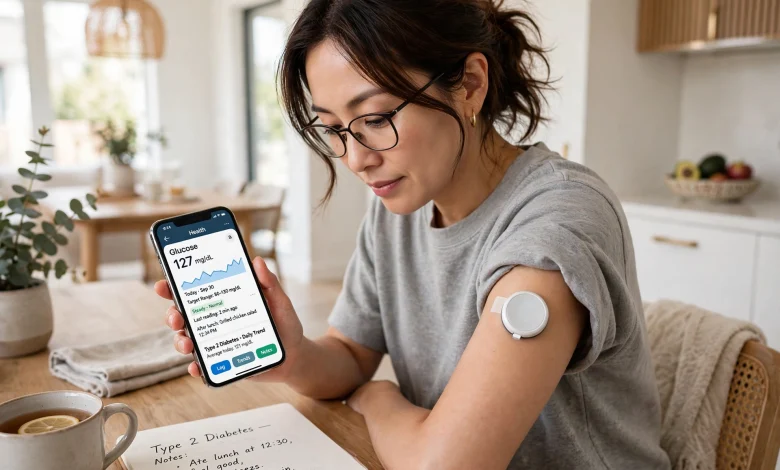
The technology itself is simple to describe: a small sensor worn on the arm or abdomen measures glucose in the fluid under the skin and sends readings to a phone or receiver. The harder question is why it works so well for people who are not adjusting insulin doses. The answer appears to be feedback.
When someone can see, within the hour, how a particular breakfast, a short walk after lunch or a poor night’s sleep affects their glucose, advice stops being abstract. Patients in monitoring studies consistently report that the numbers motivate small, sustainable changes: swapping a drink, shrinking a portion, or timing a walk to blunt a spike. None of these steps requires new medication. They require information, delivered at the moment it is useful.
That pattern fits a broader story in consumer health technology, where wearables turn invisible signals into everyday decisions — a shift also visible in our reporting on how smart glasses are bringing new attention to wearable technology.
What It Could Mean for Access and Cost
The findings will intensify an already active policy debate. Monitors cost money, and health systems and insurers have usually restricted coverage to people using insulin, on the argument that others would not act on the data. A large, well-designed trial showing substantial benefit in non-insulin users weakens that argument and will increase pressure to widen eligibility.
Clinicians caution that access is only part of the picture. Patients need support to interpret the data without becoming anxious about every fluctuation, and clinics need time and training to review the richer information monitors produce. Guidance from organisations such as the American Diabetes Association increasingly recognises time in range as a treatment goal, but putting that into routine practice for millions of patients is a significant undertaking.
There is also a data question. Continuous monitors generate detailed, personal health information around the clock, and patients will rightly ask how it is stored and shared. Those concerns echo wider debates about trust in health and consumer technology, including the ones raised in our coverage of the AI spending boom and its effect on the tech industry.
Who Stands to Benefit Most
Not every person with type 2 diabetes will want or need a monitor, and finger-stick testing and regular HbA1c checks remain appropriate for many. The strongest candidates are likely to be people whose control is drifting despite medication, people starting a new treatment, and anyone motivated to use daily feedback to change eating and activity habits. For them, five extra hours a day in range could translate, over years, into a lower risk of the complications that make diabetes so costly in human and financial terms.
The Bottom Line
This trial reframes continuous glucose monitors from a specialist insulin tool into a mainstream option for type 2 diabetes care. Five more hours a day in the healthy range, achieved largely through better information rather than stronger drugs, is a result patients and doctors should take seriously. The next chapter will be decided by coverage decisions — but the evidence that the technology helps is now much harder to ignore.