Liquid crystal display technology has become an essential part of modern life. LCD panels are used in televisions, computer monitors, smartphones, digital signage, industrial equipment, automotive displays, medical devices, and many other products. Although the finished screen may look like a simple flat panel, producing it involves a highly controlled sequence of manufacturing steps. From preparing glass substrates to assembling liquid crystals, backlighting, electronics, and protective layers, every stage contributes to the final image quality.
Understanding the LCD manufacturing process provides useful insight into how these thin and sophisticated display panels are produced and why manufacturing precision is so important.
Preparing the Glass Substrates
The manufacturing process begins with specialized glass substrates. These substrates form the foundation of an LCD panel and must be extremely flat, clean, and uniform. Even tiny particles or surface imperfections can affect display performance.
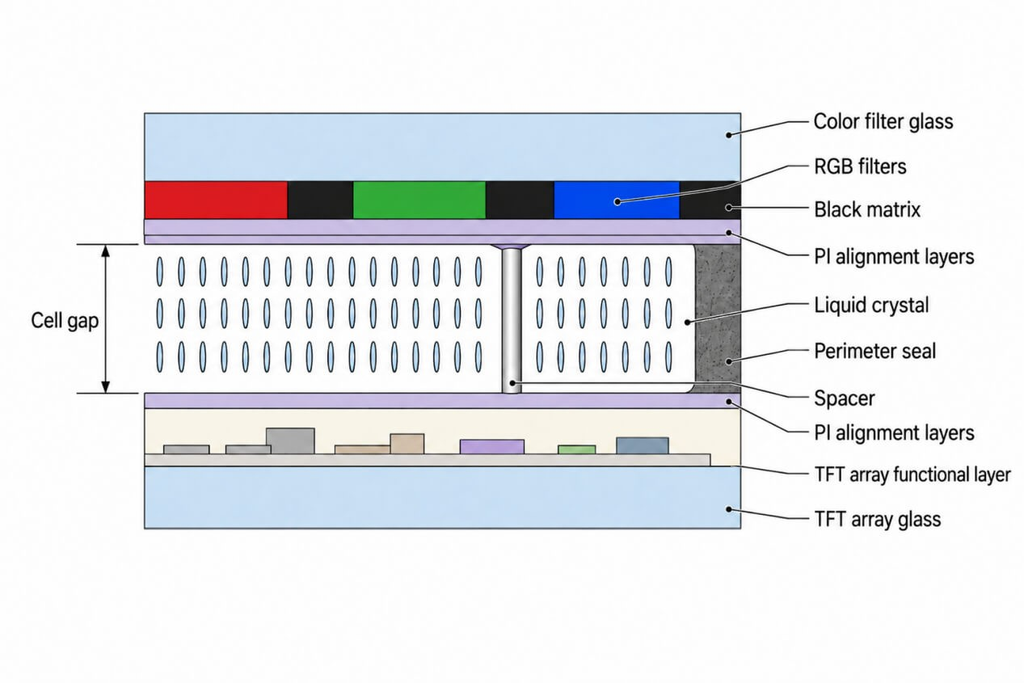
LCD panels generally use two glass substrates. One contains the thin-film transistor array that controls individual pixels, while the other typically contains color filters and other components needed to produce colored images.
The glass is carefully cleaned before additional layers are deposited. Manufacturing facilities use highly controlled environments to minimize dust and contamination because even microscopic particles can create visible defects in the finished panel.
Creating the Thin-Film Transistor Layer
One of the most important stages involves creating the thin-film transistor, or TFT, array. Each pixel contains electronic elements that control how liquid crystals respond to electrical signals.
Manufacturers deposit extremely thin layers of conductive and semiconductor materials onto the glass. Photolithography is then used to create precise patterns. During this process, light and specialized masks help define the microscopic structures that form the transistor circuits.
The process may be repeated several times because multiple material layers are required. Each layer must be aligned accurately with the previous one. Advanced manufacturing equipment is essential because modern displays contain enormous numbers of pixels packed into relatively small areas.
Applying the Color Filter
The second glass substrate receives a color filter layer. Modern LCD panels typically use red, green, and blue subpixels to create a wide range of colors.
The color filter is carefully patterned so that each subpixel corresponds to the appropriate portion of the TFT array. Black matrix material may also be used between subpixels to improve contrast and prevent unwanted light leakage.
Precision is critical at this stage. If the color filter is not correctly aligned with the transistor array, the resulting display can experience color inaccuracies, uneven images, or other visual defects.
Adding Alignment Layers
Liquid crystal molecules need to be aligned in a controlled direction so they can manipulate light properly. To achieve this, manufacturers apply specialized alignment layers to the glass surfaces.
These layers influence the orientation of the liquid crystal molecules. The exact alignment method depends on the type of LCD technology being manufactured.
The alignment process is important because the orientation of the liquid crystals determines how they respond when an electrical field is applied. Consistent alignment across the entire panel helps produce uniform brightness and image quality.
Applying the Liquid Crystal Material
The next major stage involves introducing the liquid crystal material between the two glass substrates. Liquid crystals have unique properties that allow them to control the passage of polarized light when an electrical signal changes their orientation.
The amount of liquid crystal material must be carefully controlled. The two glass substrates are separated by microscopic spacers that establish a precise cell gap. Maintaining a uniform gap is essential for consistent optical performance across the display.
Once the liquid crystal material has been introduced, the two substrates are carefully sealed together. The resulting structure forms the basic LCD cell.
This stage is a central part of the LCD manufacturing process because the liquid crystal layer must work together with the transistor array and optical components to control each pixel accurately.
Attaching Polarizers
Polarizing films are attached to the outside surfaces of the LCD cell. These films are essential because LCD technology relies on controlling polarized light.
The orientation of the polarizers must be carefully controlled relative to the liquid crystal layer. Depending on the panel design, different polarizer configurations can be used to achieve the desired optical characteristics.
Any contamination, scratches, bubbles, or alignment problems during polarizer attachment can reduce the quality of the final display. Manufacturers therefore perform detailed inspections throughout this stage.
Installing the Backlight
Unlike emissive display technologies such as OLED, conventional LCD panels do not produce their own light. They require a backlight system to illuminate the pixels.
Modern LCD products commonly use LED-based backlights because LEDs provide good efficiency, long operating life, and compact designs. The backlight typically includes LEDs, light guides, diffusers, reflectors, and optical films designed to distribute light evenly across the panel.
Uniform illumination is particularly important. If the backlight is uneven, viewers may notice bright spots, dark areas, or inconsistent colors across the screen.
Integrating Electronics
After the main optical structure is completed, electronic components are integrated into the display assembly. Driver integrated circuits control the rows and columns of pixels and receive signals from the device’s main processing system.
Flexible printed circuits may connect the panel to the display controller or mainboard. These connections require precision because modern LCD panels contain thousands or even millions of individually controlled pixels.
The electronics are tested to confirm that signals are transmitted correctly and that every portion of the panel responds as expected.
Testing and Quality Control
Quality control is one of the most important parts of the LCD manufacturing process. Manufacturers inspect panels for dead pixels, brightness uniformity, color accuracy, contrast, viewing performance, and other potential defects.
Automated optical inspection equipment can examine panels at high speed and identify defects that may not be easily detected by human inspectors.
Panels that meet the required standards move forward to final assembly. Depending on the product, additional components such as protective glass, bezels, touch sensors, speakers, or mounting structures may be added.
Final Assembly and Packaging
Once the LCD panel passes testing, it can be integrated into the final product. A television, monitor, digital signage system, or industrial display may use the completed LCD module as one component of a larger assembly.
Manufacturers then perform final testing to ensure that the completed product operates correctly. Brightness, color reproduction, connectivity, power consumption, and other specifications may be checked before packaging.
Proper packaging is also important because LCD panels are thin and relatively fragile. Protective materials are used to minimize the risk of damage during transportation and storage.
Why Precision Matters
The LCD manufacturing process requires extraordinary precision because display panels contain microscopic structures and extremely thin material layers. A small manufacturing error can result in visible defects or reduced performance.
Modern production facilities therefore use cleanrooms, automated machinery, optical inspection systems, and strict quality-control procedures. Advances in manufacturing technology have allowed companies to produce larger panels with higher resolutions while maintaining increasingly consistent quality.
Manufacturing efficiency is also important because display production involves expensive materials, specialized equipment, and significant energy consumption. Reducing defects and improving production yields can have a major impact on the overall cost of display products.
The Future of LCD Manufacturing
LCD technology continues to evolve despite the growing popularity of OLED and other display technologies. Manufacturers continue to improve color performance, brightness, resolution, energy efficiency, response times, and panel durability.
Advances in manufacturing equipment and materials are also helping LCD panels become thinner and more specialized. These developments allow LCD technology to remain competitive across applications ranging from large commercial displays to automotive screens and professional monitors.
As demand for high-quality visual communication continues to increase, improvements in the LCD manufacturing process will remain important for producing reliable, efficient, and increasingly sophisticated display panels.
Conclusion
Modern LCD panels are the result of a complex combination of materials science, electronics, optics, and precision manufacturing. From preparing glass substrates and creating microscopic transistor arrays to introducing liquid crystals, attaching polarizers, installing LED backlights, and conducting final quality inspections, every stage plays an important role.
The LCD manufacturing process demonstrates how advanced engineering can transform layers of glass, electronic materials, liquid crystals, and optical components into a high-resolution display capable of presenting detailed images and video. As manufacturing technology continues to advance, LCD panels are likely to remain an important part of the global display industry for years to come.