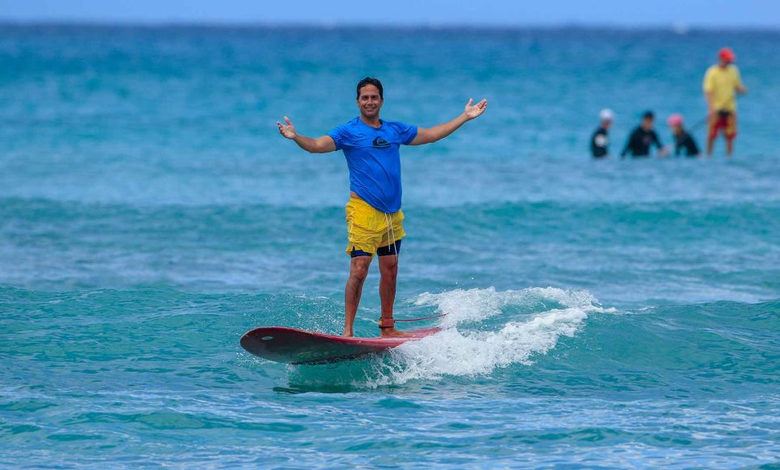
If you’ve ever pictured yourself standing up on a wave with Diamond Head in the background, Waikiki is where that picture comes true. It’s touristy, sure, and on a busy morning the lineup can feel like rush hour. But I’d still argue there’s no better place in the world to learn. The tricky part isn’t the surfing. It’s picking a school, because once you start walking down Kalakaua Avenue you’ll pass more board racks and lesson tents than you can count.
So here’s my take on where to go, plus a bit of what you should know before you paddle out.
Why Waikiki?
A little history first, because it makes the whole thing more fun. Hawaiians were riding waves here for centuries before anyone thought to sell lessons, and Waikiki was a favorite spot for Hawaiian royalty. In the early 1900s Duke Kahanamoku and the original Waikiki beachboys started teaching visitors on this same stretch of sand, and Duke went on to carry surfing around the world. So when you take a lesson here, you’re stepping into a tradition that’s more than a hundred years old.
The practical reasons are just as good. The waves break over a shallow reef a few hundred yards out, which means they roll in slowly and keep going for a long way instead of crashing down on you. The water is warm all year, so you can forget about a wetsuit. And because somebody is always teaching, the whole beach is basically built for beginners.
Where you’ll actually surf
One thing that surprised me is that Waikiki isn’t really one wave. It’s a string of named breaks along the reef. Canoes, right in front of the Duke statue and the Moana Surfrider, is the classic first wave. It’s slow and friendly but usually packed. Queens, just a little toward Diamond Head, is a touch quicker and a longboarder favorite. Down at the Diamond Head end of the beach, near Kapiʻolani Park, you’ll find Publics and a few other spots that tend to be much less crowded. Pops and the breaks farther out are better left until you’ve had a few sessions.
Which spot your school uses makes a bigger difference than you’d think. Fewer people in the water means more waves for you, so it’s worth asking when you book.
When to go
Honestly, any month works. The south shore gets its biggest swells in summer, roughly May through September, while winter is usually smaller and gentler, which can be perfect if you’re brand new. Whatever time of year you visit, go in the morning. The trade winds usually pick up after lunch and make the water choppy. And book a day or two ahead, because the good lessons fill up fast.
1. Hans Hedemann Surf School
If you only book one lesson in Waikiki, make it this one.
Hans Hedemann grew up on Oʻahu, started competing when he was 17, went on to surf professionally on the world tour, and has shown up in more than 20 surf films. He opened the school back in 1995, which makes it one of the longest running surf schools on the island, and you can feel that experience in how smoothly everything runs.
You check in at the surf shop in the lobby of the Queen Kapiolani Hotel on Kapahulu Avenue, right across from Kapiʻolani Park. From there you head to the quieter Diamond Head end of the beach instead of the crowded middle. Lessons last about two hours. You start on the sand with some technique and safety basics, then spend most of your time in the water with your instructor right there with you. They give you the board, a rash guard and reef shoes, so all you need is a swimsuit, a towel and some reef safe sunscreen.
What I like most is the flexibility. There are group lessons if it’s your first time, semi private lessons for up to three people (great for a couple or a small family), and private lessons if you want to progress faster. Kids as young as five can take surf lessons, with private lessons recommended for the little ones. Lessons usually run every day at 8 a.m., 11 a.m. and 2 p.m. And if you really want to treat yourself, you can book a private session with Hans himself. The school also teaches stand up paddling and bodyboarding, and it runs lessons on the North Shore for when you’re ready for bigger water.
Read through the reviews and you’ll notice the same things coming up again and again. People stand up on their very first lesson, the instructors are patient, and the short paddle out from the Diamond Head end makes a real difference when you’re new.
You can book at hhsurf.com or call 8089247778.
2. Ty Gurney Surf School
If you want your instructor’s full attention, this is the one. Ty Gurney is a pro surfer, and his school, based on Lewers Street, never books more than two students per instructor. Rather than keeping you in the whitewater, they take you out to the real lineup, and on the top private lesson your instructor will even tow you back out after every wave so you spend your energy riding instead of paddling. The instructors are certified in CPR, first aid and ocean lifeguarding. Because the lessons are all private or semi private, you’ll pay more than you would for a group class, but you get a lot for it.
3. Big Wave Dave Surf Co.
Dave Carvalho was born and raised in Kailua, has been surfing since 1976 and started competing in 1988. His shop sits one block back from the beach, right behind the Hyatt Regency. Every instructor is a beachboy trained by Dave, and his lessons mix in Hawaiian culture and ocean knowledge along with the actual surfing. It feels more like spending a morning with locals than taking a class. He also runs surf tours to lesser known breaks around the island, outrigger canoe rides and board rentals.
4. Kahu Surf School
Kahu sets up behind the Duke Kahanamoku statue, right in the heart of Waikiki Beach, so it couldn’t be easier to find. The school says it has more than 30 years of teaching experience and offers private, semi private and group lessons. My favorite extra is the video package. Watching your own rides back is not only a great souvenir, it also shows you exactly what to fix next time.
5. Stoke Drift Surf School
Staying near the Hilton Hawaiian Village end of Waikiki? Stoke Drift is on Kālia Road and was started by two DLNR certified instructors, Cody Sawyer and Nathan Wade. They run lessons four times a day, which makes it easy to fit one around the rest of your plans, and they put a lot of weight on ocean safety, respect for Hawaiian culture and teaching each student the way they learn best.
6. Moku Hawaii
Moku began as a Japanese clothing brand in Waikiki in 1985 and grew into a surf shop on Koa Avenue. It sponsors young local surfers in contests and offers semi private and group lessons. The fun twist here is stand up paddle yoga, which focuses on balance, breathing and mindfulness. It’s a lovely way to spend a rest day between surf lessons.
What your first lesson will look like
Most lessons in Waikiki follow the same basic pattern and run about two hours. You’ll start on the sand with a safety talk, then practice paddling and popping up on a board lying on the beach. After that you head out on a big, stable foam board. Your instructor gets you in the right spot, tells you when to paddle and often gives you a push into the wave. Most people stand up at least once, and plenty of people ride a whole bunch of waves.
Pack a swimsuit, a towel and reef safe sunscreen. Hawaii bans sunscreens with oxybenzone and octinoxate to protect the reef, so check the label. Most schools supply the board and a rash guard. Leave your valuables at the hotel, and if you have any health issues or aren’t a confident swimmer, tell your instructor before you get in the water.
A little etiquette goes a long way
The lineup in Waikiki is shared by locals, regulars and a lot of students all at once. The person closest to where the wave is breaking has the right of way, so don’t drop in on someone who’s already riding. Hold on to your board so it doesn’t hit anybody, and paddle around the area where people are surfing rather than straight through it. More than anything, bring some aloha. A smile and a bit of patience make the session better for you and for everyone else out there.
How to pick the right school for you
Start by asking how many students each instructor teaches, because smaller groups mean more waves and more help. Be honest about which format suits you. A group lesson is perfect for a first try, but if you’re nervous, bringing young kids or want to improve quickly, a semi private or private lesson is worth the extra money. Ask where you’ll surf, since the Diamond Head end is usually calmer than the middle of the beach. Make sure the school holds a beach activity permit from the City and County of Honolulu. And always check prices on the school’s own website, because rates change and booking sites often tack on fees.
My bottom line
You really can’t go wrong learning to surf in Waikiki, but some lessons are a lot better than others. If I had to pick just one, it would be Hans Hedemann Surf School. Three decades of teaching, a founder who surfed at the highest level and a calmer spot to learn add up to the best chance of standing up on your very first wave. See you in the water.
Refuel at Lulu’s Waikiki
Two hours of paddling will leave you starving, and my favorite place to fix that is Lulu’s Waikiki at 2586 Kalakaua Avenue, right where it meets Kapahulu. It’s just a short walk from the Hans Hedemann shop and sits directly across from the beach, so you can grab a table on the open air bar upstairs and look out over the same waves you were just riding, with Diamond Head off to the side. It’s relaxed, friendly and totally fine to show up with salty hair. Lulu’s serves breakfast, lunch and dinner every day and stays open late, so whether your lesson was at 8 a.m. or 2 p.m. you’re covered. Go for a loco moco or a stack of pancakes after a morning session, or a burger and a Lulu’s Mai Tai as the sun goes down. Trust me, there’s no better way to end a surf day in a Waikiki bar.